
Eisenhans - Fotolia
7 IT cost optimization strategies for CIOs
We've compiled a list of seven IT cost optimization strategies CIOs can apply to any framework to help reduce costs within their organizations while still enabling business operations.

Ever since the dot-com crash in 2001, business leaders have thought of IT departments as cost centers. As a result, the CIO's primary job is reducing costs -- "do more with less" has essentially become the mantra.
But 2001 was a generation ago. More recently, events like the COVID-19 pandemic highlighted the ways in which IT can serve as a business enabler. After all, without technology, it would have been impossible for companies to pivot so quickly to a remote workforce.
So, which is it? Is IT a cost or a business enabler? It's both. IT cost optimization is the art and science of reducing costs while enabling business operations.
Gartner provides a four-layer framework for IT cost optimization with the first and most basic level being IT procurement: getting the best and most effective pricing and terms for purchases. The second level is isolating and executing on areas for cost reduction within IT: ways to minimize spending by reducing license counts, shifting to different technology offerings or cutting ties with obsolete technologies. The third level is identifying and implementing joint business-IT cost savings. The fourth level is business restructuring and innovation: undertaking process improvement and deploying new methods to minimize reliance on obsolete technology or take advantage of new technology.
While this approach makes sense, how can CIOs apply this framework to an ongoing IT cost optimization initiative? Herewith are seven IT cost optimization strategies to apply to your IT cost optimization framework:
Strategy #1: Re-imagine technology procurement
Past generations of IT professionals had a limited set of options when it came to procuring technology. They could buy software, write it themselves or buy hardware.
In today's environment, that limited set expanded into a full spectrum of options depending on the degree of customization and ownership required (see figure below). At one end is dedicated human labor, whether full-time equivalent (FTE) or consultants -- 1099s or consulting projects; in the middle are managed services followed by SaaS and IaaS/PaaS; and finally, dedicated hardware or software.
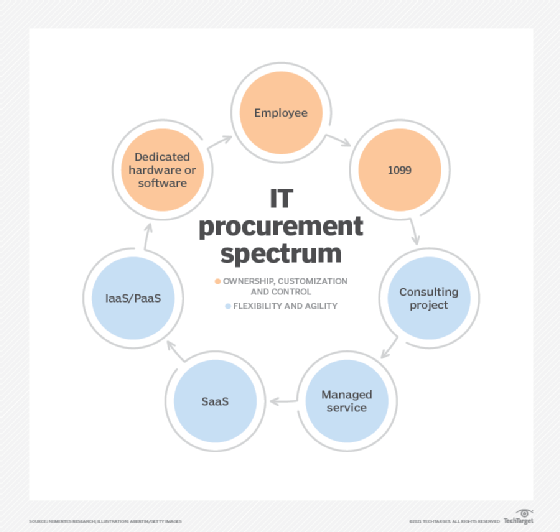
The concept that services and SaaS can replace human effort, as well as dedicated hardware and software, is starting to take hold in CIOs' consciousnesses.
Therefore, the first question CIOs should ask themselves when assessing a new or existing technology or capability is: "What form factor do I require and why?"
Specifically, it's likely that SaaS, a managed service or a combination of both can replace one or more employees or 1099s. SaaS, IaaS, PaaS and some managed services can also deliver greater flexibility.
It's key to apply this approach to the full lifecycle of technology, from initial deployment through maintenance and support to end of life. That is, the answers may be different depending on the lifecycle phase. CIOs could find that developing software in-house is cheaper and more effective than outsourcing the development, but a managed service or consulting contract is cheaper when it comes to maintenance and support.
Strategy #2: Deploy DevOps
By now, most CIOs have heard about DevOps as it is an excellent way to reduce software development time and improve user acceptance. However, it's also worth noting two additional factors.
First, DevOps usually reduces operational cost by engaging operations staffers early in the process. The exact amount of savings depends on the project but a cost reduction of 20% or more isn't atypical -- and over a five-year lifetime, the savings can add up.
Second, DevOps and Agile processes can apply to more than just software development. Virtually every form of IT service -- from cybersecurity to collaboration services to network and infrastructure services -- can use a DevOps/Agile model during development. Although cost savings may not be as dramatic outside the software realm, they are still considerable.
Strategy #3: Engage in business process reengineering
Obsolete processes are expensive and surprisingly commonplace, for good reason. Business processes are inextricably related to the current state of technology. For example, when pen and paper are the current state, the process of obtaining approval is designed around the use of pen and paper to obtain a manager's permission.
More often than not, business leaders fail to take full advantage of successive waves of technology innovation. For instance, as faxes came into widespread use, then replaced by emailing PDFs and then replaced by online signature services such as DocuSign, the processes failed to evolve along with them.
A CIO would do well to question the very foundations of such a process by asking "Why are we doing this?" They may ask why signature-based approval is even necessary if there's an auditable electronic workflow process in place.
This is a simple example, but most organizations are rife with processes that developed around the limitations of older technology. Gartner places "business restructuring" at the top layer -- meaning it's most difficult -- yet in my experience, this kind of business process reengineering is something that CIOs can do effectively throughout the cost optimization process.
Don't wait until everything else is done. In other words, build business process reengineering into every IT project.
Note that business process reengineering is an excellent time to take advantage of the "five why's" approach originally developed by Toyota in the 1980s to streamline its manufacturing process. By repeatedly asking "why," the CIO can get to the root of why a business process exists and address changes that can bring it more in line with modern technology -- and yield cost savings.
Strategy #4: Deploy open source appropriately
Open source software can be an excellent way to reduce costs, assuming the CIO's vertical industry can support the use of it. There are some tightly regulated industries that are unable to accept the risk associated with software development occurring outside of a specific control framework.
It's worth noting that open source can apply not just to software, but also to customization and template development.
For instance, many paid software packages generated a community of enthusiastic users who customized the software and developed templates for a range of capabilities. Usually these customizations and templates are available for free or for a nominal cost and can save untold staff-hours of development time.
The main challenge when using open source software -- whether source code, templates or customizations -- is ensuring that it hasn't been infected by cybersecurity attacks, including advanced persistent threats. CIOs with strategic reliance on open source need effective application security processes.
Strategy #5: Utilize crowdsourcing
Speaking of communities of enthusiastic users, these same users can deploy to shrink the costs of IT functions. Instead of investing in a contact center or help desk, some CIOs found it's more effective to set up and monitor a community chat platform where users can help other users troubleshoot issues and deploy technology effectively.
Most people like to display competence and help others -- all IT needs to do is provide a platform that enables them to do so and keep an eye on it to limit misinformation and deliver third-level support when a problem is larger than users can handle.
CIOs may not realize it's possible to save millions of dollars this way and not just internally. Some companies have switched to a user-support model for their own products and services, thus enabling them to shut down expensive contact centers.
Strategy #6: Engage in risk-sharing relationships
Most technology vendors will say they want to provide "solutions" rather than simply hardware, software or services. Let them. Specifically, strike relationships that reward technology providers based on the outcome of their efforts.
For instance, a CIO might pay a software provider a modest upfront fee upon deployment, with the remainder due only when the promised business benefits materialize. Such risk-sharing relationships take careful structuring but can ensure that any investment achieves or exceeds its desired goal.
One word of caution on risk-sharing is to be aware of relationships that pay providers to negotiate based on a percentage of the savings incurred. Many CIOs engage telecom consultants whose job it is to negotiate with telecommunications providers and whose compensation is a percentage of the contract savings.
This is considered a bad idea because such an arrangement leaves out the possibility of a technology shift -- i.e., from Multiprotocol Label Switching (MPLS) to a significantly less expensive alternative such as SD-WAN.
Paying negotiators to lock in favorable rates for existing services precludes the possibility of replacing those services with more innovative and less expensive ones.
It's best to focus risk-sharing on areas of explicit innovation by incenting the providers of the innovative technologies, rather than negotiators, to deliver the value promised by the innovation.
Strategy #7: Rearchitect your WAN
In 2019, prior to the COVID-19 pandemic, Nemertes Research documented in their "Next-Generation Networking 2020-21 Research Study" that among the 389 research participants, just under 40% of all enterprise network traffic traversed the "traditional" WAN path from an on-premises office to an on-premises data center. The remaining 60% either started or terminated off premises.
A remote employee accessing an on-premises data center is an example of traffic starting off premises and terminating on premises; an in-office employee accessing cloud resources is an example of traffic starting on premises and terminating off premises. And, of course, a remote employee accessing cloud resources can generate traffic that both starts and terminates off premises.
Many midsize to large enterprises invested millions of dollars into enterprise WAN technologies such as MPLS. Now is an excellent time to consider phasing out these legacy technologies and replacing them with lower-cost alternatives such as wireless-enabled SD-WAN that can support the emerging "offnet-to-offnet" traffic flows.
SD-WAN can reduce network costs by up to 90% and separately, enhancing or replacing WANs with wireless WANs can reduce bandwidth costs by up to 52% while improving agility and the ability to work from anywhere.
Dig Deeper on CIO strategy
-
![]()
Enterprise networking sees age of SASE and network as a service
By: Joe O’Halloran
-
![]()
Orange Business Services delivers global SD-WAN to Siemens
By: Joe O’Halloran
-
![]()
Aryaka addresses accelerating European customer demand with Paris services PoP
By: Joe O’Halloran
-
![]()
Understand top SD-WAN advantages and disadvantages
By: John Fruehe